
22 October 2026 8 min read
Suspension Cuffs vs Bondage Cuffs
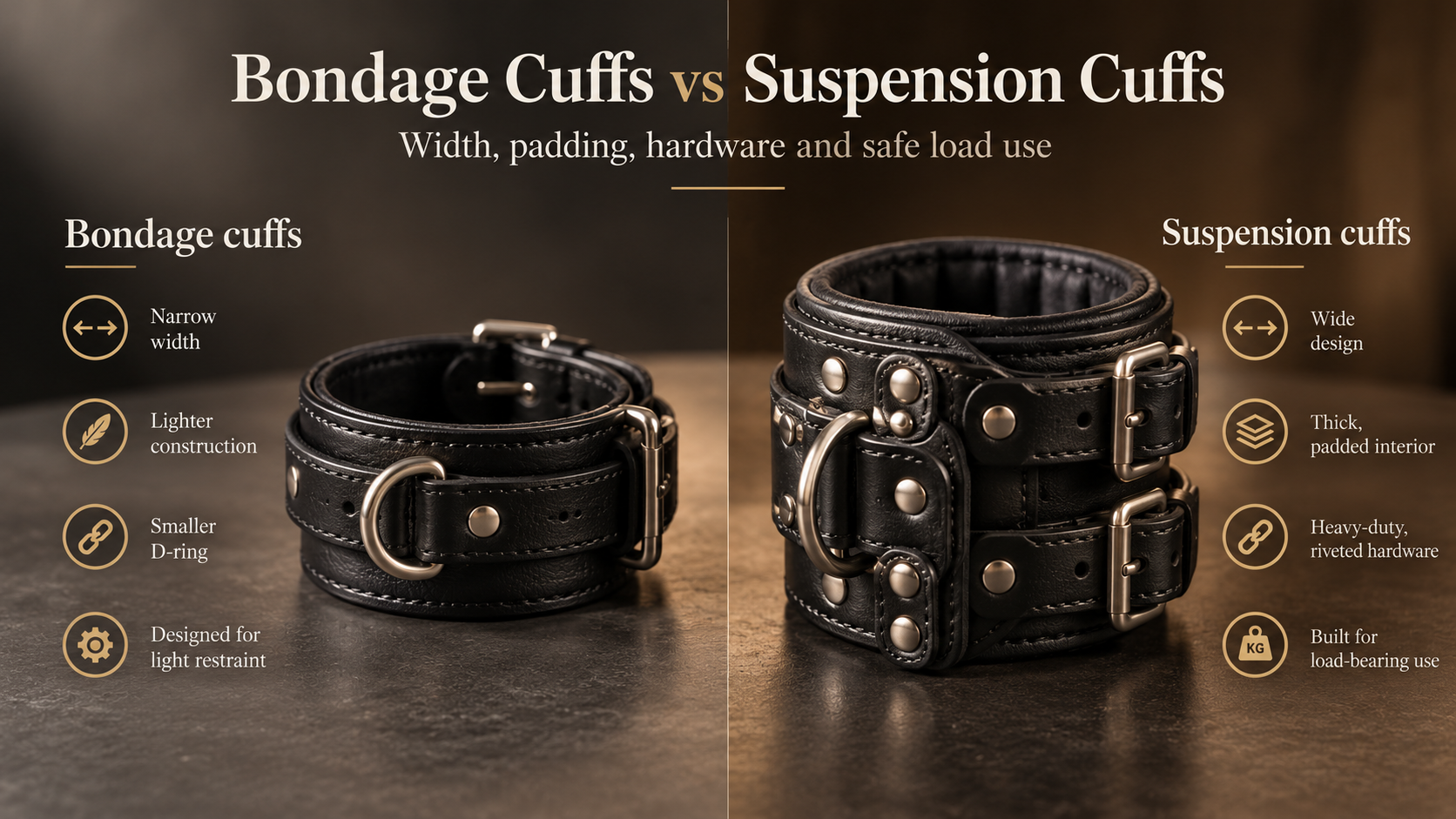
Suspension cuffs are built to carry weight. Normal bondage cuffs are not.
A standard bondage cuff holds a wrist or ankle in place for light restraint, such as tying hands to a bed. A suspension cuff is wider, thicker and padded, with heavier hardware, so it can take the pull of a tie-down, a hogtie or part of a person's body weight.
They can look alike in photos. The difference is in the leather, the width, the padding and how the metal parts are fixed. Pick the wrong one and a cuff can tear, slip or press on a nerve.
Feature | Bondage cuffs | Suspension cuffs |
|---|---|---|
Main job | Hold a limb in place | Carry load at the wrist or ankle |
Width | Narrow, often 4 to 6 cm | Wide, often 7 cm or more |
Leather | Light leather, PU or nylon | Thick full-grain or saddle leather |
Padding | Thin, or none | Thick padded inner cuff |
Closure | One buckle, Velcro or a lock | Two or more buckles |
Hardware | Light D-ring, often stitched on | Solid D-rings fixed with rivets or a riveted panel |
Typical price | £10 to £70 | £35 to £180+ |
Safe for weight | No | Partial suspension, with training |
Widths and prices are typical ranges from current UK listings, not fixed rules. Always check the maker's own specs.
What Are Bondage Cuffs?
Bondage cuffs are wrist and ankle restraints made for BDSM play. They are wider and softer than metal handcuffs, and they usually close with a buckle, Velcro or a small lock. (Wikipedia)
Most sets come as four cuffs, one for each wrist and ankle. A D-ring on each cuff lets you clip them to each other, to a bed or to a spreader bar.
They are made for holding, not lifting. Even good leather bondage cuffs are not designed to take a person's weight.
What bondage cuffs are good for
Tying wrists or ankles to a bed frame
Linking wrists behind the back
Clipping to a spreader bar on the floor or bed
Light hogties where the body rests on a surface
In all of these, the body is supported. The cuff only stops the limb moving away.
What Are Suspension Cuffs?
Suspension cuffs are a heavier class of bondage cuff, made to take load during suspension bondage. Wikipedia's entry on suspension bondage calls them the safest and most comfortable choice for wrist suspension, because they spread the weight across the wrist.
That spreading is the whole point. A narrow strap puts all the force on a thin band of skin. A wide, padded cuff shares it over a larger area.
How suspension cuffs are built
Thick leather. Full-grain cowhide or saddle leather that does not stretch under strain.
Wide cuff body. Often 7 cm or more across, so pressure is spread out.
Padded lining. A cushioned inner layer, usually leather over foam, sits between the skin and the outer cuff.
Two or more buckles. Extra buckles stop the cuff twisting or rolling when pulled.
Fixed hardware. D-rings are riveted on or held by a riveted leather panel, not stitched to a single strap.
Double stitching. Seams are sewn twice so they do not split under tension.
You can see these features on our padded suspension cuffs, where each pair is joined by a riveted panel with a centre D-ring.
What suspension cuffs are used for
Partial suspension, where the body stays partly supported
Hogties and tie-downs with strong pull
Inverted ankle work, with a trained rigger
Any scene where the cuffs take tension for more than a few seconds
Why the Difference Matters: Nerves and Load
The main risk with any wrist restraint is pressure on a nerve. The wrist has very little padding of its own, and several nerves run close to the surface.
The superficial radial nerve
Doctors see this injury often enough to have a name for it: handcuff neuropathy. It happens when a tight cuff presses the superficial radial nerve against the radius bone, near the thumb side of the wrist. (UMEM)
The usual sign is numbness or tingling on the back of the hand and thumb. It is mostly a loss of feeling, not strength, and the nerve can take around 8 weeks to recover.
A narrow cuff under load concentrates force in exactly this spot. A wide, padded suspension cuff spreads it out.
What research on suspension injuries shows
A 2023 study in Cureus looked at nerve injuries from rope suspension. Of 16 injuries in 10 people, 13 involved the radial nerve, almost all caused by pressure during full suspension. (PMC)
Recovery ranged from 2 minutes to 5 months. Many people recovered within days or weeks, but some needed 1 to 3 months.
The authors' advice applies to cuffs too:
Spread pressure evenly and keep it off known nerve points.
Set time limits on suspension.
Check in often and stop at the first sign of numbness.
Avoid extreme angles at the joints.
The study is small, and it covers rope, not cuffs. Its lesson is general: pressure plus time on a nerve causes injury, and wider, padded contact lowers the pressure.
Other risks under load
Wikipedia's suspension bondage entry lists falls as the main danger, along with nerve compression, poor circulation, fainting and harness hang syndrome. A weak cuff adds a further risk: a torn strap or snapped ring can drop someone without warning.
How to Tell if a Cuff Is Suspension-Grade
Many listings call any leather cuff a "suspension cuff". Check these points before you trust a pair with weight.
Feel the leather. It should be thick and stiff, not thin or bendy. Full-grain or saddle leather is the standard. PU and faux leather are not.
Measure the width. Wider spreads the load. A cuff narrower than about 5 cm is a bedroom cuff.
Look for real padding. There should be a cushioned layer you can press with a thumb, not just a fabric lining.
Count the buckles. Two buckles per cuff hold better than one and stop the cuff rolling.
Check how the D-ring is fixed. It should be riveted or held by a riveted panel. A ring stitched to one thin strap is a weak point.
Inspect the stitching. Look for double rows of even stitches with no loose ends.
Check the metal. Solid, smooth hardware. Avoid painted alloy, open rings and plastic buckles.
Ask about a load rating. A good maker will tell you what the cuffs have been tested for, or say clearly that they are for partial suspension only.
If a cuff fails any of these, keep it for floor and bed play.
Which Should You Choose?
Choose bondage cuffs if your play stays on the bed or floor. They are lighter, cheaper and easier to put on. A good set of leather bondage cuffs covers most beginner scenes.
Choose suspension cuffs if the cuffs will ever take tension or weight: hogties with strong pull, tie-downs to a frame, or partial suspension. They also suit anyone who wants a padded, more comfortable cuff for longer sessions.
If you are unsure, buy suspension-grade. A strong cuff works for light play too. A light cuff does not work for heavy play.
Safety Basics for Partial Suspension
Learn from an experienced rigger before lifting anyone, and always have a spotter.
Use a rated hardpoint or suspension frame. Never a door frame, curtain rail or light fitting.
Keep part of the body supported. Full weight on the wrists is not advised.
Fit the cuff so one finger slides underneath, with the D-ring away from the tendons.
Keep safety shears within reach.
Lower the wearer at once if you see numbness, tingling, cold skin or colour change.
Keep sessions short and check in often.
Inspect stitching, rivets and rings before every use.
FAQs
Can I use normal bondage cuffs for suspension?
No. Normal bondage cuffs are made to hold a limb in place, not carry weight. Under load they can tear, slip or press hard on the superficial radial nerve at the wrist. Use cuffs built for suspension, with thick leather, padding, two buckles and riveted D-rings.
Are suspension cuffs safe?
Suspension cuffs lower the risk compared with thin cuffs or rope, because they spread pressure across the wrist. No cuff makes suspension risk-free. Falls and nerve compression are still the main dangers, so use a rated anchor, a spotter, short sessions and partial suspension only.
Are suspension cuffs more comfortable than bondage cuffs?
Usually, yes. The wider cuff and thick padding share pressure over more skin, so they press less on any one point. Many people choose suspension cuffs for long floor scenes for this reason, even when no weight is involved.
Can I use suspension cuffs on my ankles?
Yes, if they are made for ankles. Ankle cuffs need to be wider than wrist cuffs because the ankle is larger. Inverted ankle work carries a high fall risk and should only be done with a trained rigger.
How long can you stay in suspension cuffs?
There is no safe fixed time, as it depends on the position and the person. Keep partial suspension short, check sensation every minute or two, and stop at once if the wearer reports numbness or tingling.
Keep reading
28 October 2026 8 min read
Leather Jockstrap Care: How to Clean It in 5 Steps
To clean a leather jockstrap, wipe the leather with a damp cloth after every wear, spot clean marks with a little mild soap or saddle soap, and hand wash a…
Read article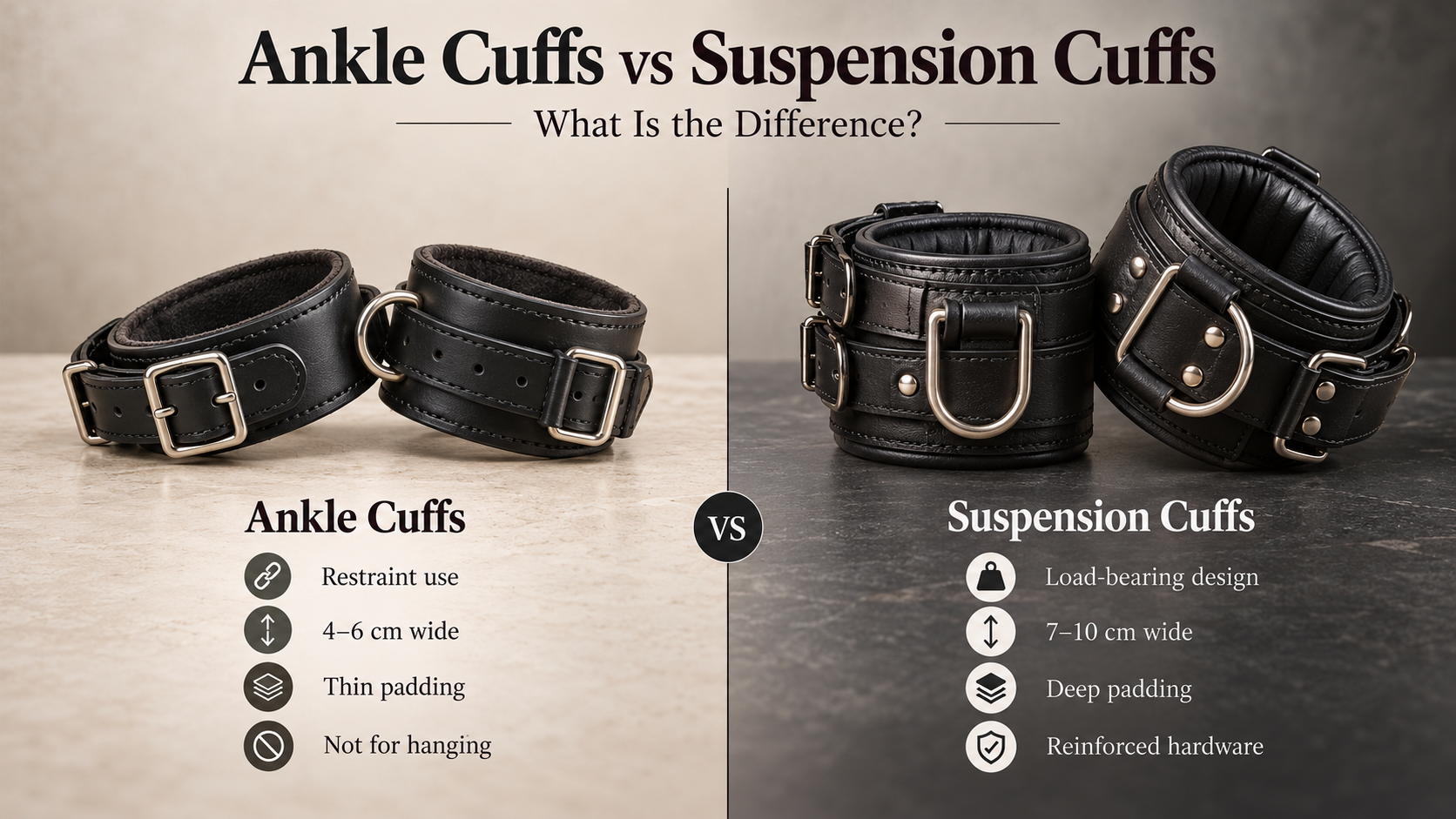
19 October 2026 5 min read
Ankle Cuffs vs Suspension Cuffs
The difference between ankle cuffs and suspension cuffs comes down to load. Ankle cuffs hold the legs in place. Suspension cuffs are built to carry part or…
Read articleSuspension cuffs are built to carry weight. Normal bondage cuffs are not. A standard bondage cuff holds a wrist or ankle in place for light restraint, such…